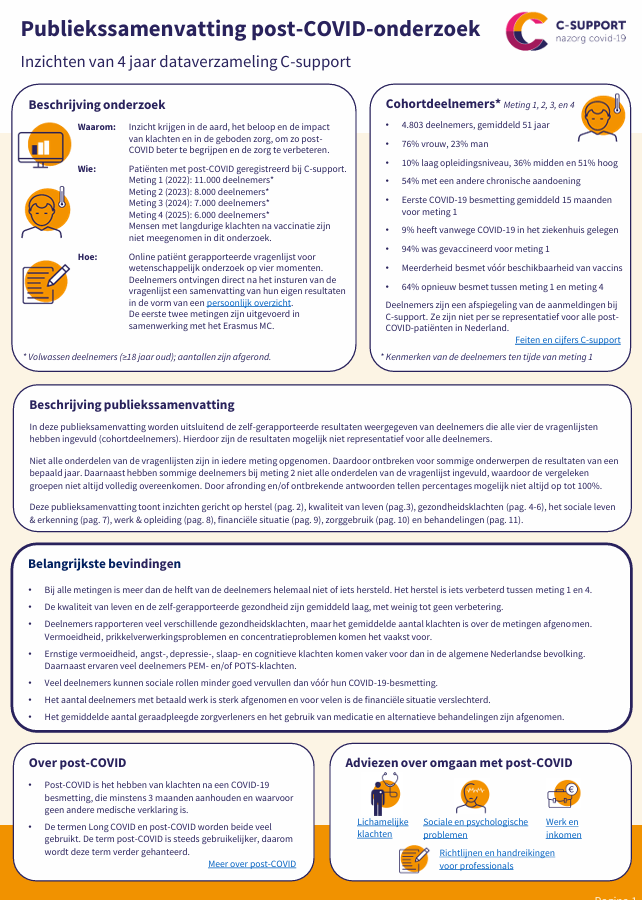
Following the completion of the Multi-Year Long COVID Study , which C-support conducted in collaboration with Erasmus MC in 2022 and 2023, C-support continued compiling personal overviews and collecting post-COVID data. Participants completed a shortened questionnaire in 2024 and 2025. A public summary of the results has now been produced. In the summary, we present the results of the cohort, i.e., of the participants who participated for four years (4.803 participants). All participants are registered with C-support.
Recovery is erratic, impact remains significant
After four years of research, it appears that the health situation of many patients improves only to a limited extent. Although some participants experience recovery, more than half have still achieved little to no recovery four years later. The consequences for health, quality of life, work, and income remain significant.
The results show that recovery is possible, but often slow and erratic. The percentage of participants who have largely or fully recovered increased from 10% to 26%. At the same time, 53% of participants indicated that four years later they were still not fully or only partially recovered. Recovery varies greatly from person to person and fluctuates over time.
Complaints remain common
The most frequently reported complaints are fatigue, sensory processing issues, and concentration problems. People experience a wide range of complaints, from an average of 18 at the first measurement to 15 at the fourth . Men experience somewhat fewer complaints. Severe fatigue, sleep problems, and cognitive complaints occur in the majority of participants, and moreover, much more frequently than in the general Dutch population. In addition, the majority of participants experience symptoms consistent with post-exertional malaise (PEM), where symptoms worsen after exertion. POTS symptoms are also regularly reported.
Low quality of life
The quality of life and perceived health of participants are significantly lower than those of the general Dutch population. On average, this changed hardly at all during the four years of the study. Moreover, many participants experience limitations in their social lives, work, hobbies, and other social roles. Loneliness is more prevalent than in the general population, and participants rate the perceived recognition for their situation at an average of 5,7.
Major consequences for work and income
The impact on work remains significant. While 94% of participants had paid work before the COVID-19 infection, this figure dropped to 48% at the latest measurement. Currently, 56% of participants receive benefits, 51% of which are WIA benefits. The financial consequences are also substantial: 61% of participants indicate that their financial situation has deteriorated due to post-COVID.
Healthcare utilization is decreasing
Participants consult fewer healthcare providers on average during the data collection period. They are most satisfied with the occupational therapist, psychologist or psychotherapist, and physiotherapist. Medication use decreases slightly, and alternative treatments decline from 45% (2nd measurement ) to 26% (4th measurement ).
Personal overview
All participants received a personal overview of their own results each year. This provided them with insight into the progression of their symptoms, the impact thereof on their lives, and their healthcare utilization. Many participants appreciate this personal overview and use it to discuss matters with their aftercare advisor, healthcare provider, employer, family, and acquaintances. They were also able to compare their results each year with those of a comparable group of patients in the form of an average personal overview.